Featuring over 350 tried and tested recipes that can be prepared at home. From comfort food to restaurant style. Plus 110+ articles on Kitchen and Cooking Tips, Restaurant Reviews and more.
Showing posts with label Awadhi Mutton Biryani. Show all posts

Tuesday, 9 July 2019

Goat Dhansak (Mutton with Red Lentils)


Another hot day here in Kansas. I am not wishing to be Dorothy because that would mean getting hit by a tornado and that is just plain cruel. However, I am sure a little respite from the sunny afternoons will be welcomed by all. My Fitbit (activity tracker) keeps on showing that I have several steps left to complete my daily target and I am like, ‘leave me be!’. It is so hot outside to go for a walk or run and so everyday I wait till sunset (to go for a walk) so that I don’t feel unproductive at the end of the day. 

So what do I do all day at home? I am done with all the unpacking so now I am rearranging. I rearrange, catch up on my reading then look for some delish recipes. It was during one of those recipe search sessions that I found today’s dish - Goat Dhansak.


When I found this recipe of Goat Dhansak on Mary Berry’s website, I had no idea that this is actually a very popular Indian dish. As I read, this dish originates from the Parsi Zoroastrian community and combines the cooking skills of Persian and Gujarati community. This is quite different than the goat curries we always have. In fact, I have seen dishes with meat and lentils several times while browsing for different recipes but I had no idea this tastes so great. The Tandoori or Mughlai section of most restaurant’s menus also have a similar dish but it’s just not the same. Traditionally, Goat Dhansak is served with rice cooked in caramel water but I decided not to go overboard with the experiments and served it with plain white rice. Needless to say, it was amazing!

I also came to know that Persian cooking uses a combination technique. Since meat is always an expensive ingredient, the quantity of the dish is increased by adding different types of vegetables and lentils. Since this is also a Gujarati dish, you will also see varieties of Indian spices in it. The original Dhansak recipe is very similar to a stew with varieties of lentils (like Arhar dal, Chana dal and Red Masoor dal) and vegetables (like potato, tomato, eggplant and pumpkin) in it. I decided to omit the vegetables because I wanted the mutton to have its gorgeous flavor.

Every dish tastes unique because of the spices added in it. This Dhansak is prepared by using a special spice mix called ‘Dhansak Masala’. This is very similar to the Garam masala I frequently use while cooking. If you have a readymade packet of powdered Garam masala at home, make sure to cross check the spices which are - Cinnamon, Cardamom, Cloves, Nutmeg, Coriander Seed and Cumin Seed. 


If you don’t have a pressure cooker at hand, then definitely give this dish at least two hours to cook. We don’t want to consume any uncooked meat. When cooking in a cooker, cook the meat half way by browning it first and cooking it for one or two whistles, then add the rest of the spices, lentils and give it another whistle or two. Pressure cooker definitely reduces the cooking time by a lot so you may want to go for it. However, I somehow feel that slow cooked mutton tastes a lot better than pressure cooked. I, therefore, always use my Dutch oven for cooking meat.

If you don’t like the flavor of goat, go for lamb. This recipe will taste good with either of these meats. Again, this is not an original recipe of Dhansak but it tastes amazingly good. Make sure to fry the onion well so that it develops a delicious caramelized flavor. Mint leaves are added as a garnish but they do help develop the flavors even more. Originally this dish calls for a sweet, sour and spicy flavor but I am not very fond of sour dishes and hence I haven’t used any tamarind/ lemon or lime to cook it. Traditionally pumpkin is added to add a hint of sweetness but Mary Berry has used honey and who am I to argue with the queen of flavors! Do not skip that because it will cut the heat of the black pepper and spices.


Now I know I have only prepared this once, but that was enough to convince me that I got to share this recipe with everyone so that they can also try and share their inputs. Also, whenever I don’t share a recipe, I lose it. Believe me this is an extremely good dish to lose or forget.

So, give this a try sometime and then post in the comments how it turned out. You can also post on my Instagram #lifewithoutalu with the photo and your comments/ input.


Ingredients:
  • Mutton (Goat Meat) – 1 pound
  • Onion - 1 medium, chopped
  • Ginger - 1 inch, peeled
  • Garlic - 4 cloves, peeled
  • Red Chilies - 2, broken
  • Green Cardamom - 10 pods
  • Cumin Powder - 1½ tablespoons
  • Coriander Powder - 1½ tablespoons
  • Turmeric Powder - ½ teaspoon
  • Tomatoes - 14 Oz can (or 2-medium, chopped)
  • Chicken stock - 1 cup 
  • Red Lentils - ½ cup 
  • Honey - 3 tablespoons
  • Salt – to taste (about ½ teaspoon)
  • Freshly ground Black Pepper – ¼ teaspoon
  • Mint Leaves - 3 tablespoons, chopped 
  • Ghee – ¼ cup 
  • Whole Black Peppercorns – 5-10
  • Cloves – 5-7, powdered
  • Nutmeg – ¼ teaspoon, powdered 
  • Cinnamon Stick – 1 small 
  • Bay Leaves – 2-3


To serve:
  • Boiled Rice

When cooking goat meat, long marination is the key. Try to marinate the mutton for at least 4-5 hours or overnight with the following: 
Cumin Powder, Coriander Powder, Turmeric Powder, Salt, Cloves Powder, Nutmeg Powder, Black Pepper Powder, Ginger and Garlic paste. 

Directions:
  • Heat 2 tablespoons of Ghee in a large frying pan over high heat. Use non-stick pan for an easy clean up. 
  • Add the marinated mutton in a single layer (you may have to fry it in two batches). Fry until browned. Remove from the pan and set aside.
  • Add the remaining Ghee to the pan. Reduce the heat to medium. Add the onion and fry for 4-5 minutes, or until beginning to soften.
  • Bash the cardamom pods with the end of a rolling pin to split the husks, then remove the seeds and grind them to a fine powder in a Mortar and Pestle. Add to the pan with the remaining spices (Red Chilies, Whole Black Peppercorns, Cinnamon Stick and Bay Leaves). 
  • Fry for a minute then add the remaining ingredients to the pan (Tomatoes, Chicken stock, Red Lentils and Honey). Add the fried mutton as well.
  • Increase the heat to high and bring to a boil. Then cover and simmer for 1½-2 hours or until tender. 
  • Check the seasoning. Sprinkle chopped mint leaves and serve hot with boiled rice.


Tips: 
  • If you are cooking in a pressure cooker, cook the meat half way by browning it first and cooking it for one or two whistles, then add the rest of the spices, lentils and give it another whistle or two.
  • Use a good quality non-stick pot/ Dutch Oven to cook this.


Love Goat Meat/ Lamb? Try these recipes as well:

Wednesday, 3 October 2018

Rose Water – a touch of freshness


Rose Water is widely used in Indian cooking. I read somewhere that it is prepared by steeping Rose petals in Water. Rose Water has many medicinal, cosmetic and therapeutic uses. However, since Life Without Alu? is a food blog, we will be concentrating on the culinary uses of Rose Water in this article. 

I think it’s amazing how we associate the floral fragrances with perfume and cosmetics. Believe me they do bring their own exciting flavor and fragrance when added in any dish. I am sure you have used Vanilla Extract while baking. Rose Water also adds a touch of beautiful aroma in the dishes. Be it Lassi, Kabab or Biryani I just love sprinkling a few drops for that divine fragrance. 

Now Rose Water is quite a conflicted ingredient. You will either love it or hate it. So, before using it in any dish try adding it in a beverage (like Lassi). That way you will be able to experience its fragrant, floral flavor without putting in much effort.

Before buying Rose Water make sure to check the expiration date. Also, see that it is pure Rose Water and not some diluted or synthetic stuff. Believe me good stuff makes a lot of difference. You will feel the subtle floral fragrance lifting your senses, which is not possible with artificial cheap stuff. 

While using make sure not to exceed the amount given in the recipe. Rose Water is very floral and aromatic and like Vanilla extract should be used carefully.

I always keep a small bottle of Rose Water in my fridge, even though I may not use it that often. I read somewhere that you can use it in champagne cocktails and non alcoholic punches/ summer spritzers for a touch of flavor. Mediterranean cuisine is also famous for dishes prepared with Rose Water. 

In India we have a summer drink called Rooh Afza (Rooh meaning Soul and Afza meaning Refresher). It is a non-alcoholic concentrated squash prepared with different varieties of herbs, fruits and flowers. It is dark pink in color and Rose flavored. It tastes sweet and fragrant and is served as a summer drink in Northern India. Growing up, this used to be my favorite drink after returning home from school. I think Rose has a very calming effect. It instantly soothes and comforts your senses and you immediately feel relaxed. Especially if you have faced the wrath and humidity of summer sun you will absolutely like a Rose flavored beverage.

So, next time, your recipe asks for Rose Water, don’t skip it. Get a small bottle and try it. I am sure you will fall in love with this beautiful fragrance. 


Recommended Reading:

Thursday, 8 March 2018

Awadhi Mutton Biryani


Photo and Recipe Courtesy: Dr. Debarshi Chatterji

First of all, I want to thank all my readers for waiting so patiently for this wonderful recipe. Debarshi prepared this as a surprise treat for me almost two years back and he has been making improvements in the recipe ever since. Well, I think we have perfected it now and so, I decided to share it with everyone. Now let me tell you that this is a complicated recipe so take your time and plan it accordingly. There are quite a few steps so pay attention and have patience and believe me you will have a delicious homemade biryani better than any you have ever tasted.

Now before we move on to the recipe, let me tell you a little bit about the Biryani itself. Awadhi Mutton Biryani is indeed a dish fit to be served to the royals. This is not to be cooked in a haste so make sure to keep this reserved for exceptional soirées. Use a good quality basmati rice (which is a long grained aromatic rice) and good quality boneless meat (goat or lamb). Be generous with the spices and ghee which will bring that exotic flavor and aroma in the dish. Refer to my article on Mutton Gravy for the steps to prepare the meat. 


As I have written in my article: Achari Mutton, Indian cuisine is divided into many different categories, mainly on the region from which the dish originates. Today’s dish is from the Awadhi cuisine (Mughal inspired cuisine) of Lucknow. Hence you can understand why we will be using all those aromatic spices and ghee in such an amount for after all this Biryani was custom made for the royals. Well, we may not have the digestive strength to eat this high calorie food everyday or the time to prepare it at a moment’s notice but we can certainly enjoy it on special occasions. Biryani is soul food and should be prepared and enjoyed with friends and family or when you really want to impress someone special. Believe me when I say that ever since I have come to the U.S. there have been only a few places where I have been served authentic Biryani and it always made me sad. Well, not anymore! Now I can prepare this delicious Biryani whenever I want.


The final stage of the Biryani is called ‘Dum’ which means slow cooking over a low heat and this is where your oven comes handy. The al dente rice is layered with the fried onion and cooked mutton and then sprinkled with aromatic waters. I used Kewra and Rose Water along with Saffron to create that authentic fragrance and color. You can use an aluminum foil pan to cook the biryani, although it will get quite heavier with the rice and meat in it so I recommend using an oven safe baking dish. Cover the top with foil and seal it with dough. Then leave it in the oven for two hours and relax.
Biryani is a meal in itself so you don’t have to worry about preparing anything else with it. A side salad or plain yogurt raita are the ideal combinations. Follow the steps patiently and you will be rewarded with the most delicious and heavenly dish.
Bon Appetit!


Awadhi Mutton Biryani prepared by Debarshi

Tips:
  • Refer to my article on Mutton Gravy to know how to marinate and cook the mutton.
  • We usually get Royal Basmati rice. It is available at most Indian stores and Costco.


Ingredients:
For the biryani rice:
  • Rice – 2 cups
  • Ghee – 2 tablespoons
  • Canola or Vegetable Oil – 2 tablespoons
  • Cinnamon – 1 small stick
  • Green Cardamom – 3-4
  • Black Cardamom – 1-2
  • Dry Red Chilli – 3-4
  • Bay Leaf – 1 big
  • Cumin Seeds – 1 teaspoon
  • Star Anise – 2
  • Cloves – 4-5
  • Mace – 1 
  • Nutmeg – ¼ 
  • Whole Black Pepper – 5-6
  • Salt – to taste (about ½ teaspoon)


For the final Biryani:
  • Milk – ½ cup 
  • Turmeric Powder – a pinch + 2 pinches
  • Saffron – 2 pinches
  • Red Food Color – a pinch
  • Onions – ½ cup, julienned 
  • Oil – 1 cup (to fry the onions)
  • Potato – 1 large, peeled, washed and cut into medium size cubes
  • Salt – about 2 pinches
  • Kewra Water - 2 teaspoons
  • Rose Water - 2 teaspoons


Directions to cook the Rice:
  • Wash and soak the rice in enough water for 30 minutes. 
  • Drain the water and keep it aside (use a sieve).
  • Heat a wok over high heat.
  • Add the Ghee and Oil in it.
  • Add the whole spices (Cinnamon, Green Cardamom, Black Cardamom,
  • Dry Red Chilli, Bay Leaf, Cumin Seeds, Star Anise, Cloves, Mace, Nutmeg and Whole Black Pepper) in the oil. 
  • Wait for a few seconds then add the rice.
  • Reduce the heat to medium and fry the rice gently and carefully. Use a rubber spatula. Fry till the color changes to golden. Make sure it is not burning.
  • Add 3 cups of water and Salt. Mix well.
  • Cover and cook till the rice is ¾ done. This is a very critical step so make sure to pay attention. It should be al dente. (I followed these steps: Cover and cook over low heat for 5 minutes, Stir, cover and cook for 5 minutes more).
  • Fluff the rice then switch off the heat and place on the counter top. Keep it covered.


Let’s do some preparations for the final biryani:


  • Take 2 small bowls and add 2 tablespoons of Milk in each.
  • Place both of them in the microwave and heat for 40 seconds.
  • Mix a pinch each of Turmeric Powder and Saffron in one bowl. 
  • Mix a pinch each of Red Food Color and Saffron in the other bowl. Keep aside
  • Heat a wok over high heat.
  • Fry the julienned onions till brownish red in color and crisp. Keep aside.


  • Debarshi added Potato to add a Bengali touch. Season it with about 2 pinches each of Turmeric and Salt. 
  • Fry them in the Oil on high heat.
  • Press a piece with your spatula to check if the potatoes are cooked. Deep frying usually cooks it thoroughly.


Directions to prepare the Biryani:
  • In a baking pan (I used a 3-4-inch-deep and about 8 X 12-inch pan) spread half of the ¾th cooked rice evenly.


  • Spread the fried onion evenly on the rice layer.


  • Next spread the layer of mutton, potatoes and all the mutton gravy.


  • Finally, spread another layer of rice (use all the leftover rice).


  • Pour the colored milk (Turmeric milk and Red Colored Milk) in different places keeping some white rice areas (make a small hole using your finger and pour a teaspoon or two of colored milk in it, this will help the bottom layer to soak up the color too).
  • Now sprinkle the remaining ¼ cup of milk on it along with the Kewra Water and Rose Water.
  • Cover well with a foil. 
  • Use some wheat dough to seal the foil and baking pan together. 
  • Preheat the oven to 300 F.
  • Bake for about 2 hours. You will know it is cooked because the whole house will smell like a Mughlai restaurant!
Enjoy!


Recommended Reading:

Mutton Gravy


To prepare this lip smacking Mutton Gravy, make sure to use a good quality boneless meat (goat or lamb). I highly recommend using my recipe of Garam Masala for this gravy because it will bring that exotic flavor and aroma in it.  Also, marinate the meat overnight (or up to two days), so that it develops that succulent taste. To prepare the gravy, sear the mutton pieces on high heat till the oil separates, then pressure cook. This will bring that juicy flavor in them. 

If you are making Awadhi Mutton Biryani, then proceed as it is. If you are serving this as a gravy then after cooking the meat as directed, add just a little water and adjust the Salt. Enjoy with Naan or Pulao.

Ingredients:
  • Garam Masala Powder – ½ teaspoon
  • Star Anise – 2
  • Goat or Lamb – 1 ½ pounds (preferably good boneless pieces), washed and cut into medium size pieces
  • Ginger – 1 inch
  • Garlic – 3 big fat cloves
  • Green Chili – 3-4
  • Turmeric Powder -  1 teaspoon
  • Red Chilli Powder - 1 teaspoon
  • Yogurt - 4-5 teaspoons
  • Salt – to taste (about ½ teaspoon)
  • Canola or Vegetable Oil – 2 tablespoons
  • Ghee – 2 tablespoons
  • Onion – ½ cup, finely chopped


Let’s marinate the meat:
  • Make a paste of Ginger, Garlic and Green Chili. You may use your Nutri Bullet (extractor blade).
  • Marinate with Garam Masala Powder, Star Anise, the above paste (of Ginger, Garlic and Green Chili), Turmeric Powder, Red Chilli Powder, Yogurt and Salt. 
  • Mix well to coat all the pieces. 
  • Cover and refrigerate.


Tips:
  • You should plan this ahead. Once the meat gets time to soak up all the flavors, it will be juicy and packed with the essence of all the spices.
  • Try to marinate the meat overnight or up to 2 days. This is very important. Use a plastic or glass bowl (do not use a metal bowl for this step).


Directions to prepare the meat:
  • Bring the mutton to room temperature. I usually keep it outside the fridge for an hour and then cook it.
  • Heat a pressure cooker over high heat.
  • Add the Oil and Ghee in it. 
  • Add the Onion in it. Fry until golden brown in color. (Use food chopper to chop the onion evenly and finely).
  • Now start adding the mutton pieces in it (do not add the extra marinade at this step). The high heat will bring a beautiful sear on them. 
  • Once seared, add the rest of the marinade and cook on medium heat. We call this process ‘Mangsho Kosha’ in Bengali. It will take 15-20 minutes to cook the mutton properly. Keep stirring occasionally. (I cooked 5 minutes on medium high, then 5 minutes on medium and finally 5 minutes on low).
  • When you see the oil separating, add ½ cup water and increase the heat to medium (this will help to build the pressure quickly). Mix well.
  • Attach the lid and let the mutton cook thoroughly. Usually 2 whistles should be enough to cook it. Wait until the pressure drops and the lid can be opened easily.
  • Now if you are using this to prepare the Awadhi Mutton Biryani then check the consistency, it should be like thick gravy. If there is extra water, you may dry it a bit. If on the other hand, you are serving this as a Mutton gravy then you may add a little water (adjust the Salt as well). Serve with Naan or Pulao. 


Recommended Reading:

Doing Low Carb diet? Try these as well:

Tuesday, 26 September 2017

Allahabad to America: The food I grew up with

This article has been published in the Kansas City Bengali Association Durga Puja 2017 Magazine. I am sharing it here for all my followers. 


Hi, I am Debjani and I LOVE FOOD. I cannot stress enough how much I miss eating yummy ‘deemed unhealthy’ by modern society food. Butter, ghee (clarified butter) with piping hot rice, Peyaji (deep fried onion fritters) and the list goes on and on….and Alu. OMG I hate to skip potatoes. I think most of us share my frustration for not being able to eat what you want. I wanted to tell and share with people so I started a blog, it’s called ‘Life Without Alu?’  If you agree that Life Without Alu and other “unhealthy” delicacies, is tough then read on!

The name of my blog means there is no life without Potatoes or carbs or good food and hence it features all the good, yummy recipes which are sure to make you drool. You can also find additional important kitchen organization and homemade spice making tips on my blog because when we are talking about food it covers everything.

My blog is a Travel and Food blog and hence you will also find reviews on restaurants. Debarshi (my husband) and I love to travel and I like sharing our experiences about the different places we visit and all the delicious dishes we enjoy. After all Good Food Makes Good Life.

I'm from Allahabad (India), which is known for its university and religious significance. Being the eldest child I learned a lot of things at a young age and one of them was cooking. However, it never occurred to me how much I will miss all the delicious Allahabadi food which were a day to day affair while I lived there. We all share the troubles of living so far away from our families but it also adds to the excitement of visiting the childhood home we all love. At least for me, every trip to my hometown is special and worth the wait….and I am sure it is the same for you too!

If you have never been to Allahabad, you cannot imagine all the good food you have been missing. So, I am going to take this opportunity to share with you all the delicious local Allahabadi foods. I would recommend keeping a napkin handy because this journey is going to make you drool!


(Photo shows from left: Yogurt for making the Lassi and Rabri used for topping)

It is such a sweet comfort that some things in life never change, for example the Loknath Gali in Chowk. Loknath is a busy alley in the old part of Allahabad. Stepping into this crowded narrow place springs every childhood memory back to life. When I visit, at least once, I take the same ricksha ride with my mother that we have taken so many times. Passing by the shops we used to shop at, thelas (carts) we used to grab a quick bite and alleys we have turned upside down for a matching dupatta (stole). Last time was no exception and there we were at this place doing all the things we have done so many times. Life is a cycle after all, “And as it is for spring flowers, so it is for us.”

Chowk is one of the oldest neighborhood of the city, packed with businesses, a lot like Bora Bazaar of Kolkata or Chandni Chowk of Delhi. You can literally find everything there at whole sale prices but my main attraction has always been the food. Loknath has the smell of delicious food in the air, you can smell all different types of spices, pickles and sweets. Somewhere someone will be frying Kachoris or making delicious Chaat, walk a little further and you will smell all kinds of Mithai (sweets and desserts). In short, you will find some of the most yummylicious street food. My mother and I did some shopping and then went straight to my favorite shops of Lassi and Namkeens.


In Allahabad street foods are usually served in the traditional way. The photo above shows Lassi served in a clay cup. Although lassi can be sweet or savory, traditionally lassi in Allahabad is sweet. Now this clay cup is handmade on a pottery wheel and is not only environment friendly but also instills an earthen smell in the drink. Furthermore, it is topped with cream, Rabri and nuts to add to the heavenliness.


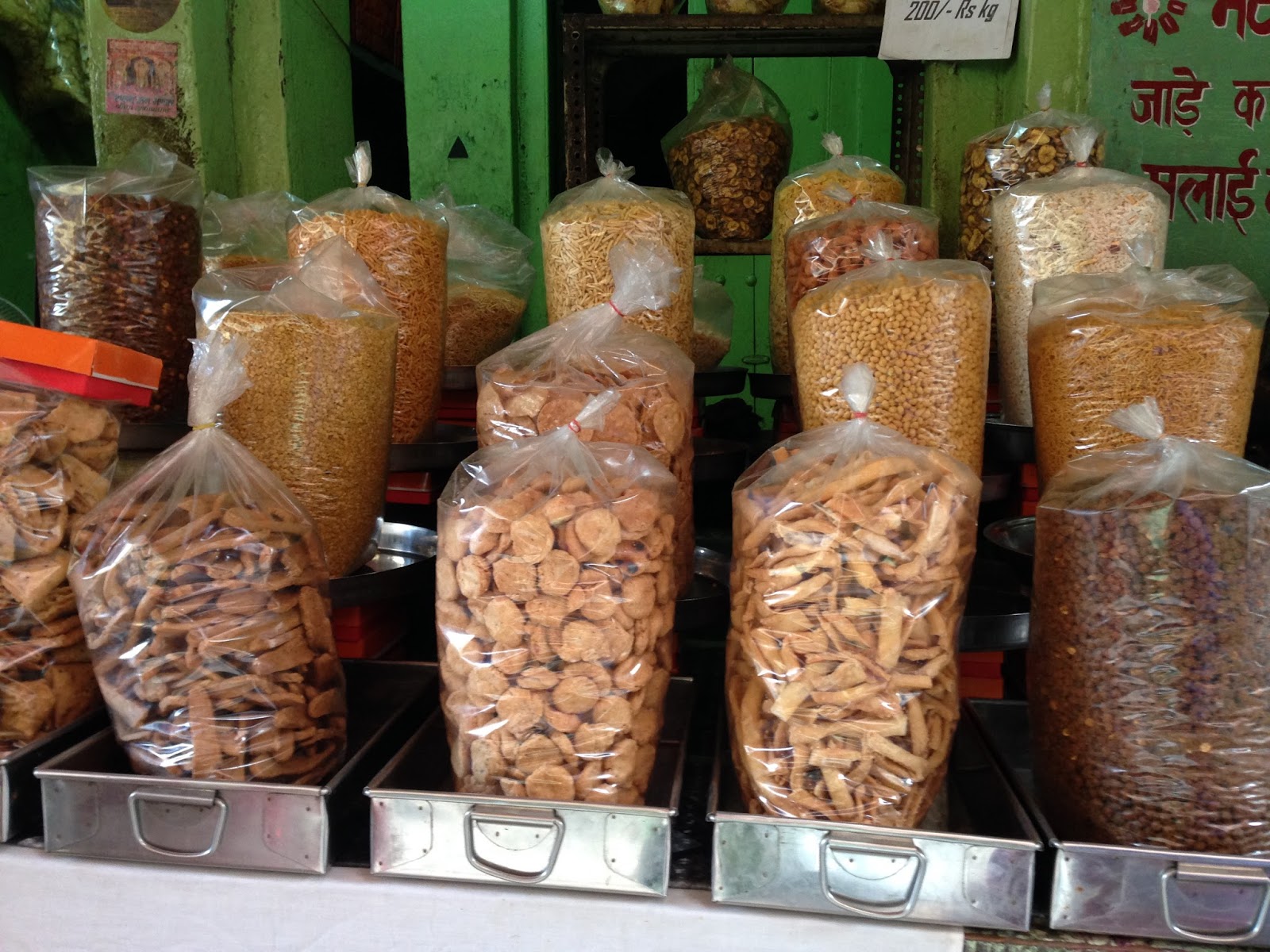
Why are these cookies piled up in huge heaps? Well for starters these are not cookies but Namkeens. Now let me tell you what this word means: Namkeen comes from the Hindi word Namak which means salt. So it basically says savory snacks.

You must have had Samosas or even Mathris from the Indian restaurants or Chaat cafes, they are also available in ready made packets in the Indian stores. If you like snacking on Indian Namkeens you have to go to this savory paradise. They have all kinds of snacks like Papri, Mathri, Kachori, Khasta (a puffed pastry made with a filling of lentils) etc. Another specialty of Loknath shops is Samosa. Normally you will find Samosas with a potato filling about medium in size but Loknath’s Samosas are prepared with a filling of lentils and spices and are smaller in size. They are called Masala Samosas and are fried in Ghee (Clarified Butter) which brings an intensified silky, rich buttery taste. All the Namkeens are freshly prepared everyday and you can store them at room temperature for weeks, believe me they don’t go bad.


(Photo shows from left: Khoya and Paneer)

Locals also go to Loknath for their day to day grocery shopping for spices, fresh produce and milk products like Paneer and Khoya (prepared by thickening and drying whole milk in an open pan, Khoya is the primary ingredient to many Indian desserts). Paneer can also be easily prepared at home by curdling whole milk with a food acid like lemon juice. This process helps to separate the liquid from the curdled milk which you can then drain on a cheesecloth. The excess water is then squeezed out and the cloth is tightly twisted to make a ball shape. You can put some heavy pot on top of the the cloth so that the Paneer holds a perfect shape. However, since all the dairy products are also readily available in the grocery shops at a very reasonable price. People usually prefer to buy fresh Paneer from the market, avoiding the trouble of preparing it at home from scratch. My mom likes to buy it from the Loknath Gali in Chowk along with Namkeens and sweets.


I feel there is something nostalgic about my mom’s cooking. I am sore that we all share the same feeling for all our mothers. The style of cooking that we grow up with, in a way becomes a part of our DNA. Don’t you agree? My mom does not use too many spices nor does she have any secrets, in fact she is always willing to share her recipes with everyone. Still, it never feels the same even if I am using the same recipe. I guess, that’s why the phrase, ‘from mom’s kitchen.’ A dish prepared by her just feels special, they just make me feel so warm and loved. When our mom’s cook (or used to cook, for those who have faced the ultimate loss) for us, every bite is like reliving childhood and reminds us of all those happy memories we shared as a family. Even a simple rice and dal tastes great when we are eating it together.


If you ever get a chance to visit Allahabad, you must have some Allahabadi Chaat. Chaat is a famous street food in most parts of India. Nowadays it has even graduated as a first course dish in several restaurants and even in weddings as appetizers. During my last three years in the U.S I have had Chaats in quite a few Indian Chaat cafes of Atlanta, San Jose and San Francisco. However, is it possible for a chatori (a person who loves to eat Chaat) like me to go to her home town and not have some delicious Chaat? Amidst my jet lag and stomach upsets whenever I was well I used to go out with my sister and enjoy some tasty Chaat from the local vendors. Allahabadi Chaat is different in many respects.  This photo features many different aspects of Allahabadi Chaat. From the top is Karela (these are crispy chips shaped like bitter gourd, prepared with a dough of all purpose flour and served with yogurt, Matar, onions and spices), Alu Tikiya (mashed potato mixed with spices and sometimes filled with paneer or lentils and shallow fried, they are served with Matar, chutney and onions), tomato for preparing Tamatar (another dish prepared by sautéing tomato pieces with cumin seeds and the Alu Tikiya dish. The tomato is cooked and mashed in the dish and spices like cumin powder are added, this is then garnished with some yogurt and cilantro) and one thing which is missing from this photo is my all time favorite – Phulki (or phuchka or gol-gappe or pani ke batashe). Goes with many names but has the same petrifying effect on foodies around the world. These are small deep fried puffed breads and these are served either with Jeera Jal or with Chutney Matar (Ghugni). Now, Matar (or Ghugni) in a Phulki is unique to Allahabadi Chaat as far as I know unlike the common practice of stuffing them with mashed potato.


Now let’s move on to another of my favorite snacks – Samosa. This is a deep fried pastry filled with spicy potato and sometimes peas. Samosas have their own versions in every state of India but its unique triangular cone like shape remains more or less the same. Although nowadays we get many versions of Samosas (filled with meat, paneer or lentils) my favorite is the traditional one where the filling is made of fried mashed potatoes and spices. I love the Samosas of Allahabad as they have the perfect crust and filling ratio. Because of their small size they are super crispy. The crust holds the filling perfectly and it doesn’t crumble with the first bite. Samosa is the most popular street food during rainy season. I have enjoyed many such Chai (Tea) Samosa party with my friends. It’s an ecstatic feeling to watch the rain pour down while gossiping and eating a hot crunchy snack. Samosas in Allahabad are usually served with the green Dhania (cilantro) chutney although sometimes it is also served with a tart Tamarind.


My parents gave me a surprise treat at the Grand Continental Hotel in Civil Lines, Allahabad and this photo features Goat Biryani. Biryani is a main course dish where meat (or even veggies) is cooked with Basmati rice because of its long grains and flavorful aroma and is often served with a yogurt raita. In our home my husband, Dr. Debarshi Chatterji is the master chef of Biryani. His specialty is Awadhi mutton biryani, which has roots of origin from the geographical area around Lucknow and Allahabad. Specialty of Awadhi mutton biryani lies in the subtle use of aromatic spices and essence. Rose water, Kewra water, mace, nutmeg, saffron and other aromatic products are used in small amounts to provide a subtle texture and aroma which enlivens the spirit.


Now let’s move on to some serious desserts. Allahabad has a bunch of western bakeries that serve cakes, pastries and patties with an Allahabadi twist. This photo features Cakes from one of the most popular bakeries of Allahabad – Paradise. This is my go-to place for delicious desserts. You can see that the cakes have been specially labelled as “Egg Cake” and that is because many cakes and pastries are also prepared eggless to cater to the high density of vegetarian population in the city. The sweet treats are endless and I for one get absolute mesmerized with all the options.


I think it will be correct to say that Indian pastries bear a remarkable similarity with French pastries. We realized this when we went to the Amelie’s French Bakery and Café in Charlotte, North Carolina. They had the exact soft pastries topped with whipped cream, chocolate and fruits. Indian pastries are actually very different than the American muffins and pies and you should definitely give it a try. So let’s see what’s on these shelves, I see Black Forest, Pineapple Exotic, Éclairs, Exotic Truffle and Mango Toon pastries.

You can also find all sorts of breads and cookies in the bakeries around Allahabad. Burgers, Sandwiches, Pizza and my favorite – Patties (or Puffed Pastries). Patties are prepared by filling a dough parcel with cooked vegetables or meat. The filling is pre cooked with spices and the parcel is then baked crisp. The flaky crispy dough tastes very much like a croissant.

I was so happy to go to this old bakery with my sister and Debarshi. We shared a couple of sweet and savory dishes and went back home happily.

There are a lot of places in Allahabad with tons of great food and I hope you will enjoy these yummy dishes whenever you are in my hometown.

Remember “People who love to eat are always The Best PEOPLE”.

Love to cook? Learn more delicious recipes on my blog – http://lifewithoutalu.blogspot.com

I would love to hear from you, please post your comments on my blog and enjoy all the good food.

Bon Appetit!


Recommended Reading: