Featuring over 350 tried and tested recipes that can be prepared at home. From comfort food to restaurant style. Plus 110+ articles on Kitchen and Cooking Tips, Restaurant Reviews and more.
Showing posts with label Alur Dom (Bengali recipe: Potatoes with gravy). Show all posts

Wednesday, 17 April 2019

Niramish Alur Dom (Potato Gravy Without Onion and Garlic)


I know I haven’t been able to post anything recently. Well, I may not have been able to work on my blog as much as I usually do but I have learned some amazing recipes. Debarshi’s parents are visiting us from India and believe it or not, I have been most fortunate by this visit. You see, I dabble and experiment with many recipes and different cuisines. However, the truth is, I don’t know many authentic Bengali recipes. So, everyday while Debarshi’s mom is preparing a delicious fish curry or a quick stir fry, I am ready with my notepad and pen and writing everything down. I am going to start this delicious journey with a simple potato gravy also known as Niramish Alur Dom. The specialty of this gravy is, it is prepared without any onion and garlic so perfect for those fasting days as well.


If you are wondering about the whole fasting thing, then let me explain. In India, we divide vegetarian food into two groups – 
  1. The regular vegetarian food which contains no meat, eggs or fish.
  2. The special fasting day approved vegetarian food which does not include certain vegetables like onion and garlic. These two vegetables are said to add flavor and heat in the food and by eliminating these two, we eliminate any lingering fragrance of the food. Personally I don’t prefer fasting, however, these dishes taste so delicious that I don’t mind cooking them. Plus, if you hate cutting onions and peeling garlic then definitely give this recipe a try.

The other recipe of Alur Dom on my blog is different. It has onion and ginger. If you haven’t yet tried it, I would highly recommend doing so. It would give you an idea of the difference in preparation and flavor of these two recipes.

My mom in law prepared this Niramish Alur Dom as a special treat for Debarshi. Debarshi asked her to prepare something authentic and she prepared this potato gravy with Koraishutir Kochuri (Pea stuffed deep fried puffed breads).


I wont make you wait anymore, here’s the recipe:

Ingredients:
  • Potato - 2 medium sized russet potatoes, peeled, cut into big pieces and washed
  • Tomato - 1, big, diced
  • Red Pepper Pods – 1-2
  • Cumin Seeds – ½ teaspoon
  • Asafoetida – ¼ teaspoon
  • Turmeric powder -  ¼ teaspoon
  • Salt – ½ teaspoon (to taste)
  • Sugar – ¼ teaspoon
  • Coriander Powder – ½ teaspoon
  • Red Chili Powder – ¼ teaspoon
  • Green Cardamom – 2, crushed lightly
  • Garam Masala – ¼ teaspoon
  • Mustard Oil – about 3 tablespoons

Directions: 
  • Boil the potatoes.
  • Heat a non stick pan on medium- high heat.
  • Add the oil in it. Heat it till it smokes then reduce the heat and add the Red Pepper Pods, Cumin Seeds, Asafoetida and Green Cardamom.
  • Add the tomatoes with the spices (Coriander Powder, Red Chili Powder, Salt, Turmeric powder and Sugar).
  • Keep frying this till the oil begins to separate.

  • Add the Potatoes in it along with the stock (water in which the potatoes were boiled) and mix well. 
  • Add the Garam Masala and adjust the Salt and cover and cook for a couple of minutes to let the spices blend with the Potatoes. Keep the heat on low at this time.
  • When the gravy reaches your desired consistency Niramish Alur Dom is ready. Serve with Koraishutir Kochuri.


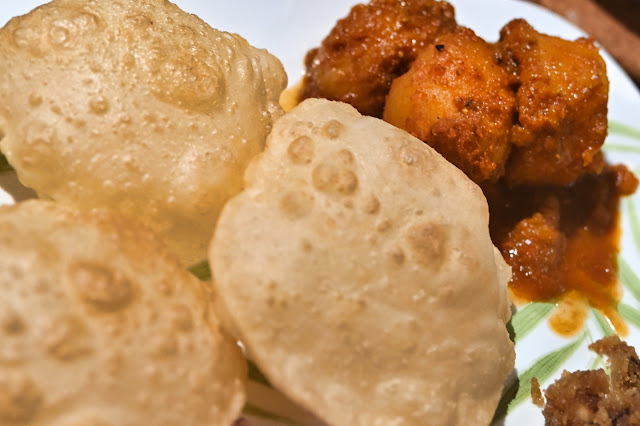
Photo shows the other recipe of Alur Dom with Luchi (puffed bread).


Recommended reading:

Thursday, 24 August 2017

Alu Chochori (Bengali recipe: Potatoes with Indian Spices)


Photo Courtesy: Dr. Debarshi Chatterji


I usually try to prepare Debarshi’s favorite dishes on his birthday. So, Payesh, Bhat, dal, Panch Bhaja with Mangsho are all a big yes! I start his birthday celebrations with his favorite breakfast – Luchi ar Alur Dom. However, this year, Debarshi asked me to prepare a different torkari (vegetable dish). He said that he was craving for his mom’s Alu Chochori (Potatoes with Indian Spices). So, I said why not, it’s your birthday and you will get whatever you desire.


Photo features (from top right): Payesh (Bengali Rice Pudding), Mangsho (Goat Curry), Dal (lentils), Panch Bhaja (deep fried vegetables) and Bhat (rice).


Photo features: Luchi ar Alur Dom (Deep Fried Puffed Bread with a Potato gravy)


So, the next day, I called my mom-in-law and got the recipe from her. Now this is a very plain and easy dish. You wont have to buy anything special for this torkari. In fact, if you have prepared any Indian torkari before, you will have an idea how to prepare this dish.

If you are a potato lover, you will love this torkari. The soft cubes of potatoes with the tomato ginger gravy will truly satisfy all your potato cravings. This hot and sweet Alu Chochori goes very well with a crisp fhulko Luchi but you can also enjoy it with plain Parathas.

Now if you check the ingredients, you will find something new, which you may not have used before - Kashmiri Mirch. This chili brings a bright red color to the food and is used mainly in the preparation of tandoori dishes. Kashmiri Mirch is just like Paprika, not hot to taste but a very good spice to create the rich color in the curries and other dishes. If, however, you would like the dish to be hot, add some Green Chilies or Red Chili Powder in it. You can easily get the Kashmiri Mirch Powder from your local Indian store.


Photo features: Tandoori Chicken and grilled zucchini and bell peppers with a side salad

We will also be using some Whole Wheat flour in this dish. Alu Chochori is a dry dish and the addition of Tomato pulp and Ginger paste will leave some gravy. In dishes like this, where you want the gravy to cling with the vegetables, using a little flour is a good idea as it absorbs all the extra water from the gravy and leaves this beautiful thick coat of spices on the Potatoes. Sprinkle the flour slowly over the Chochori and mix and you will immediately see the flour absorbing the extra water.

Serve the Alu Chochori hot with Luchi or Paratha.


Ingredients:
  • Bay Leaf – 1 or 2
  • Dry Red Chili – 1 or 2
  • Potato - 2 big russet potatoes, cut into small cubes
  • Oil – about 3 tablespoons
  • Asafoetida – about ¼ teaspoonPanch Fhoron – about ½ teaspoon
  • Turmeric Powder -  ¼ teaspoon
  • Salt – to taste (about ½ teaspoon)
  • Sugar – ½ teaspoon
  • Ginger -  about 1 inch
  • Tomato - 2, medium
  • Coriander Powder – ¼ teaspoon
  • Kashmiri Mirch – ½ teaspoon
  • Whole Wheat Flour – 1 tablespoon


Let’s do a little prep:
  • Take the Tomato and Ginger and make a paste. You may use Nutri bullet or a food processor for this.


Directions to prepare the Alu Chochori: 
  • Heat a wok on medium- high heat.
  • Add the Oil in it.
  • Pat dry the Potatoes.
  • After about half a minute, add the Bay Leaf, Dry Red Chili and Asafoetida. 
  • Wait for a few seconds, then add the Potatoes in the wok.
  • Fry till the Potatoes are golden red in color.
  • Now add the Ginger and Tomato paste in it and mix well.
  • Reduce the heat to medium and fry for 5-7 minutes. 
  • Add the spices (Turmeric Powder, Salt, Coriander Powder and Kashmiri Mirch) in it and mix well.
  • Reduce the heat to medium low and cover and cook for 5-7 more minutes. 
  • Add the Sugar and mix well to let it blend with the Potatoes and the paste.
  • Reduce the heat to low and add just a little water (maybe 1-2 tablespoons) and cover for another 2-3 minutes to thoroughly cook the potatoes.
  • Now the torkari is ready, if you still see some gravy, sprinkle some Whole Wheat Flour on it which will help to absorb the extra water and make the spices stick on the Potatoes. 
  • Serve with Luchi or Paratha.


Recommended reading:

Wednesday, 10 May 2017

Luchi – Deep Fried Puffed Bread


Photo features: Luchi and Alu Kumror torkari (Deep fried puffed breads with a Potatoes and Pumpkin stir fry).


The thought of gaining a few hundred calories over brunch is not going to stop me from enjoying a crusty hot Luchi.

Luchi or Puri as we call it in Hindi is one of the most loved and eaten breads in almost every Indian home. Kids love its crusty puff and eat it first to enjoy the crunch. Be it a weekend brunch, fasting day or a special meal for the guests Luchi is always there. The Luchi dough is kneaded with oil or ghee and a little salt which creates that nice crust on it and brings a savory taste in it. Luchi can be enjoyed with any stir fry or curry of your choice.


Now although I have eaten Luchi hundreds of times at my parents’ home, I actually took the recipe from my mother in law while writing down another of her special recipes- Alur dom. Debarshi loves Luchi and Alur Dom and I try to prepare this whenever I can. Since Luchi is deep fried, it’s loaded with calories and I will suggest you to limit this for special occasions only like I do. If you love fried bread, then a good alternative to Luchi is Paratha which is prepared by shallow frying the rolled out dough on a skillet. It is easier to prepare and is comparatively a healthier option.


Now let’s talk about the preparation and techniques. Luchi dough will not have any leavening agent in it like baking powder or soda and hence we will be adding a good amount of oil which we call moen in Bengali. This helps to make the Luchis crisp and puff up while frying. I love adding some carom seeds as well. They not only inculcate a complex aroma in the Luchis but also help prevent any stomach disorders. While kneading the Luchi dough pay special attention, if it starts getting sticky then don’t be afraid, continue kneading so that the dough absorbs all the extra water. I always use lukewarm water to knead the dough and once it turns smooth, I leave it to rest for at least 15 minutes. A Luchi will be smaller than your palm almost the size of a small round bread roll. So you will have to roll a few extra Luchis per head because everyone will be eating a few more. I always transfer the hot Luchis in a colander lined with a paper towel so that it can absorb the extra oil and the steam can escape.


Luchi goes great with any Sabji or curry but I just love it with a Bhaja like Begun Bhaja or Bhindi Bhaja (deep fried Eggplant or Okra with turmeric and salt). Luchis are temperamental so even after doing all the steps correctly it’s possible they won't puff up. Don’t worry they will still taste great. However, do check the correct temperature of the oil by doing the test and do read the frying tips.

So this weekend how about some Luchi Torkari? Try it and let me know.

Bon Appetit!


Photo features: Luchi and Alur Dom (Potatoes with gravy)


Ingredients:
  • All Purpose Flour – 2 cups
  • Whole Wheat Flour – ½ cup
  • Oil – 6 teaspoons (used while kneading the dough) + 2 cups for frying
  • Water – about 8 tablespoons (add more if required), lukewarm
  • Salt – about ½ teaspoon
  • Carom Seeds – about 1 teaspoon (optional)

Directions for Kneading the Dough:
  • Wash your hands, you will be using them a lot. If using stand mixer, attach the Bowl and Hook to your Stand Mixer and connect it.
  • In a large bowl mix the All Purpose Flour, Carom Seeds (if adding) and Salt together. Mix using either your fingers or a whisk or run the mixer on the lowest speed until it's all well mixed.
  • Now add the Oil. Mix with your fingers until you get a sandy texture or run the mixer again for a minute or two.
  • Add water, a little at a time, and knead into a dough. You may need a few extra tablespoons of water if the dough feels tough. We need a tight dough so do not add a lot of water otherwise it will become gooey and too soft. Keep kneading it for another minute or two. 
For stand mixer
  • Start the mixer on lowest speed and slowly add a little water in the flour. I give it time to knead and form the dough. If the sides are sticking with the bowl too much I switch off the mixer and clean the sides using a spatula. I keep it running until the dough begins to come together adding a teaspoon of water at a time. At this stage it will look dry, make sure not to add too much water at this stage. We need a tight dough so do not add too much water. Keep running the mixer. 
  • Now sometimes the dough turns out a bit stickier I usually add a little flour or a tablespoon of oil and keep it kneading until it's smooth and almost non sticky. 
  • When the dough feels smooth, remove the hook and cover the bowl with a kitchen towel or a plastic wrap and let the dough rest for at least 15 minutes. 

Directions to roll the Luchis:
  • Once the dough has rested, re-knead the dough for a few seconds. Then divide the dough into 2 equal parts. Roll each part into a log like a thick breadstick. Divide both the logs into 14 equal pieces. 
  • Now these 14 pieces will make 14 Luchis. Take a piece of dough between your palms and roll it into a ball. Press the ball between your palms lightly to flatten it a little like a disc. Put all the other balls of dough back in the bowl and cover it. This will prevent the dough from drying out.
  • Now let’s roll the Luchi, if we have added the correct amount of oil (moen) while kneading the dough, then the dough will roll smoothly and you will not need any flour for dusting. This will also bring a smoother texture and make the Luchis flaky. However, if you find it difficult to roll, you can always use a little All Purpose Flour.
  • Place the disc on the rolling board and start rolling it. It should be small and round and not too thick. A little unevenness in shape is ok. 
  • Now we are ready to start frying the Luchis. You may want to roll a few extra Luchis before starting the first batch. Make sure you are not putting the rolled out Luchis on top of each other. Keep them on a cookie sheet or a big platter on a single layer and cover them with a kitchen towel.

Directions for frying the Luchi:
  • Heat oil in a deep frying pan or wok over medium- medium high heat.
  • Test the temperature of the oil by dropping a small ball of dough into the oil. If there isn’t any bubbling, then the oil isn’t ready. If it’s furiously bubbling and there is smoke, that’s too hot. If the temperature is perfect the dough ball will take a dip and immediately float to the surface of the oil and start changing color.
  • At this perfect temperature, add one Luchi at a time and do this very carefully. Fry the Luchi by gently pressing it down with the frying spoon at different places.
  • Turn over when puffed up (or after a couple of seconds) and fry the Luchi till golden brown.
  • Transfer the fried Luchi on a paper towel or napkin to absorb the excess oil.
  • Serve the Luchi hot with Alur Dom or any other Torkari or curry.

Tips:
  • Switch on the exhaust fan.
  • I find it ok to multi task for this recipe but if at any point you find it overwhelming you may want to do one step at a time. If you do want to multitask, here is an easy tip: roll out a few Luchis then fry them one by one on medium high heat. This will help you to pay proper attention while frying the Luchis. Then lower the temperature and start rolling out the next batch. When you have rolled out 4-5 Luchis, increase the temperature again and repeat.
  • The perfect frying temperature is very important for making puffy Luchis. So, keep checking the temperature.
  • If you are not able to fry a perfect puffy Luchi, it maybe due to the oil temperature, so, try to maintain an even temperature. Remember, preparing deep fried bread is a difficult task which needs patience and experience.
  • Even if your Luchis do not puff up, they will still taste great so do not throw them out.
  • Make sure not to use a lot of flour while rolling the Luchis, this will leave a lot of burnt flour in the oil and you will not be able to re use this oil for the next batches.
  • I usually line a Colander with two paper towels and keep the fried Luchis in it. The holes of the Colander allow the steam of the hot Luchis to pass through thus maintaining the crispiness.
  • Finally, as I said earlier do not pile the rolled out Luchis on top of each other as the uncooked flour will stick together. Keep them on a single layer.
  • While the dough is resting, use that time to prepare the torkari or set the table.


Recommended Reading:

Friday, 17 February 2017

Alu Borir Torkari (Potatoes with sun dried Lentil Dumplings)


Before I start talking about this recipe, let me ask you, do you like Potatoes? And if you are nodding your head, my next question is, do you like Bengali comfort foods like Alur Dom, Alu Kumro or Alu Koraishutir Ghugni? Because if you do, you will definitely love this simple potato curry. The good part is, you will not need any special spices to prepare this torkari, however, today I am going to introduce you to something very special – Bori (or Bari) and don’t worry you can easily get this in your local Indian store.

Bori is a sun dried dumpling prepared with lentils and until a few years back it used to be something prepared by the ladies of the family. It was done as an additional chore and I have seen Mummum (my grandma) and my mom spending quite some time on the rooftop totally immersed in the Bori making process. Now let me tell you, preparing Bori from scratch is a time consuming and tedious job and hence nowadays everyone buys them readymade from stores. This gives us the convenience of cooking it anytime, not to mention, the store bought Boris last longer and taste excellent and although we won't be making any Boris from scratch, I think it’s interesting to know how they are prepared.


So Bori is prepared in two phases. Phase one is mainly prep – I have seen my mom prepare Boris with Urad Dal (Black Gram lentils). She would soak the dal overnight in water and then grind it with spices like Fennel, Black Pepper, Asafoetida, Salt, Red Chili and Ginger. The resultant batter should have a thick consistency that is, thick enough to drop and maintain its shape. For phase two, my mom would go on the roof top, spread a big cloth over a table and drop the batter on it using a spoon or her hands. The Boris should be like medium sized dumplings. After this, my mom would cover them lightly with another cloth so that any dust carried away with the wind does not sticks on the wet dumplings (we are on roof top remember?) and place some pots or pans around the cloth so that it does not glides away with the wind. She would then allow the dumplings ample time to get sun dried and crisp. So my mom would leave the Boris on the roof top for the entire day and check them in the evening and if they have dried up all over, she would store them in airtight jars. 

I once asked my mom how she knows if the Boris are actually dry and she smiled and said, “Well, if they are wet they wont come off the cloth”.

So now that you know the entire process, you must be feeling quite thankful to those hardworking people who do all these steps and make it easier for us to just purchase the Boris and cook this awesome torkari anytime we want. Now, let’s not wait any further and start cooking.


Ingredients:
  • Potato - 2 medium sized russet potatoes, cut into medium sized cubes
  • Lijjat Urad Masala Bari – 4-5 pieces
  • Tomato - 2, medium, cut into small pieces
  • Green Chilli – 1-2, slit in half lengthwise 
  • Panch Fhoron – ½ teaspoon
  • Turmeric powder – ½ teaspoon
  • Salt – ½ teaspoon
  • Coriander Powder – ¼ teaspoon
  • Oil – about 2-3 tablespoons


Directions: 
  • Heat a wok on medium- high heat.
  • Add the Oil in it.
  • Pat dry the Potatoes.
  • After a couple of seconds, add the Panch Fhoron and Green Chilli in it.  
  • When the spices start sputtering, add the Potatoes. 
  • Fry till the Potatoes are reddish brown in color.
  • Add the Boris.
  • Fry for about two minutes then add the Tomato, Turmeric powder, Salt and Coriander Powder in it and mix well.
  • When the Tomatoes start melting, turn down the heat to medium low and add about 1-2 cups of water in it. Mix well.
  • Cover and cook for about 15-20 minutes so that the Potatoes are well cooked. 
  • Press a piece of Potato with the spatula and if it breaks the torkari is ready. 
  • Serve with Roti, Luchi or Paratha.

Tips: 
  • Once the torkari is ready, I break the dumplings into two- three pieces. This helps to incorporate their flavor in the curry.


Recommended reading: