Featuring over 350 tried and tested recipes that can be prepared at home. From comfort food to restaurant style. Plus 110+ articles on Kitchen and Cooking Tips, Restaurant Reviews and more.
Showing posts with label Allahabad - The City of Good Food. Show all posts

Friday, 11 August 2017

Alu Tikiya ki Chaat (Crispy Fried Potato Patties with Dried Peas, Yogurt, Chutney and Spices)


Photo courtesy: Dr. Debarshi Chatterji
Recipe Courtesy: Mamma (Sumita Moitra)

As I wrote in my previous article (Meethi Chutney Matar Phulki), I decided to prepare some yummy Chaat at home from scratch. The idea was to have a fun evening with our favorite Indian street foods. 

Every Chaat lover knows that Phulki is just a start, you have to continue the lip smacking journey with some delicious Tikiya and who else can give me a perfect Tikiya recipe other than my mom? For those who don’t know, enjoying a plate of hot steaming Chaat with your mom, sister or girl friends is another heavenly experience. Those few minutes when no one talks, other than the occasional requests to the Chaat wala, ‘bhaiya thoda aur chutney de do’ (brother, can you please add some more chutney in my Chaat?) and once everyone finishes eating, the planning for the next Chaat meeting starts. I think it’s amazing how our heart can feel so content just by eating a few plates of street food which are normally the most inexpensive foods you can ever find.

Now, I have tried other recipes of Alu Tikiya before but my mom’s recipe is easy and quick. All you need to do is boil and grate the potatoes and mix it with a little flour which will help to bind together the potatoes and make a nice round patty. The flour will also absorb the extra moisture of the potatoes. The patty will be prepared by shaping the potatoes in a round shape and patting them down a bit to flatten them. After that they are fried twice and served hot. 

When ready to serve, arrange all the ingredients (Chutney, Yogurt, Onion, Masala and Alu Tikiya) in different bowls on the table so that everyone can assemble the final dish themselves as per their liking. I do hope that you will also enjoy this dish as much as we did.


Ingredients:
  • Potatoes - 2, cut into halves, washed, boiled, drained and peeled
  • Salt - to taste (about ½ teaspoon)
  • Oil – to fry (about 2 ½ cups)
  • Green Chilli - 2, chopped
  • All Purpose Flour – about 2-3 tablespoons, or as required

Serve with:


Directions:

  • Let the potatoes cool down completely. 
  • Grate the potatoes using a grater.
  • Mix the Salt and Green Chilies in it.
  • Mix a tablespoon of Flour in it. If the mixture feels sticky, add some more flour. You will see the texture changing. The flour will start absorbing the extra moisture.
  • Start rolling the balls. Apply a little oil on your palms, this will help you to roll the balls easily without sticking the potatoes all over your fingers. 
  • Once you have rolled all the balls, start flattening them and smooth the sides so that they don’t crack. The flour will make the patty look smooth.
  • Heat a skillet over medium high heat. Add 2-3 tablespoons of Oil in it.
  • After a minute, start adding the patties in it in a single layer. Do not over crowd the skillet, add only 5-6 patties at a time.


  • Carefully turn each patty over with a spatula and cook the other side until they look reddish golden in color then transfer them on a paper towel.
  • We will fry them again later, 5-10 minutes before serving so that they are hot and taste crispy and not greasy. Heat a wok over high heat. Add about 2 cups of oil in it.
  • Press the patties lightly with your palm so that they flatten even more. Be careful not to break them.
  • Drop the patties (carefully) in the oil and fry them till they are reddish brown in color and crisp up.
  • Serve them with Yogurt, Matar, Onion, Chutney and Masala.

Tips:

  • Use the leftover Alu Tikki (if any) to prepare delicious sandwiches or burgers. Use Cilantro Chutney or ketchup with onion rings to add more flavor.
  • Check my article on Meethi Chutney Matar Phulki for the recipe of Matar and Masala.
  • Once you drain the potatoes and peel them, you can leave them in the colander on your kitchen counter for a while. This will dry them up automatically.
  • Different potatoes develop different textures when boiled. Increase or decrease the amount of flour accordingly. The purpose of adding the flour is to reduce the stickiness of the grated potatoes.
  • Use russet potatoes.
  • Use a grater.
  • You can use the same skillet to re-fry the Tikiyas, no need to use the wok and less to wash!
  • When serving to guests, fry the Tikiyas before hand and keep them warm and crisp by placing them in an oven safe dish. Heat the oven to the lowest temperature (170 degrees F) and place the Tikiyas inside the oven. When ready to serve, they will be just as warm and crisp as if they have been freshly fried.

Recommended reading:

Thursday, 10 August 2017

Meethi Chutney Matar Phulki


As you have read in my articles numerous times, I am an absolute street food lover. Specially the foods from my home town Allahabad hold a unique place in my heart. However, this time I decided not to go for just one plate of my favorite foods from the local Indian Chaat café. Instead, I decided to make it a fun evening. So, I got a couple of items from the Indian store and made myself and Debarshi some yummy Chaat!


Now I am sure you can get a recipe of making Phulki from scratch online but I decided to get a big box of readymade Phulki. I also got a hot mango chutney which was lip smacking delicious. 

Assembling Meethi Phulki is easy and is a fun activity for the kids as well. They can mix and match the different items on their plates and eat whatever way they like. So, let’s move ahead and see what all ingredients we will need:


Ingredients:
  • Phulki – 1 big box 
  • Plain non-fat Yogurt – 2-3 cups, whipped
  • Chutney – Hot Mango or Tamarind, ½ cup
  • Onion – ½ cup, chopped finely


For the Masala:
  • Chaat Masala – 1 teaspoon
  • Roasted Cumin Powder – ¼ teaspoon (optional)
  • Black Salt – ½ teaspoon
  • Dry Red Chilies – 4-5, coarsely grinded


Matar:
  • Dry White peas – 1 cup
  • Turmeric – ½ teaspoon
  • Salt – ½ teaspoon (or to taste)
  • Baking Soda – 1/8 teaspoon
  • Red Chili Powder – ½ teaspoon


It’s always better to plan ahead whenever you are making Matar. Since they are dried peas they need to be soaked in water before cooking (just like dried kidney beans or chick peas). I usually wash and soak them in normal tap water overnight. However, you can also speed up the process by soaking them in hot water for 3-4 hours. Keep warming the water every hour so that they get enough warmth to soften up. 

Let’s do a little prep:
  • Wash the white peas and soak them in enough water overnight.
  • Drain the water and add the peas in a pressure cooker with about 2 cups of fresh normal tap water.
  • Add Salt, Turmeric and Baking Soda and mix. 
  • Attach the rubber and the whistle on the lid and cover the cooker.
  • Heat the cooker on medium heat and wait for 2 whistles.
  • Turn off the heat and let it cool down.
  • Once the pressure drops and the lid opens, press a pea with your spatula to check if it has been cooked through. 
  • If you feel there is too much water in the peas, dry the excess water by putting the cooker without the lid on the gas oven over high heat. Keep stirring occasionally till you get the required consistency. The peas should not be too dry neither too watery.
  • Add the Red Chili Powder and mix.
  • Matar is ready!

Directions to assemble the yummy Meethi Phulki:
  • Take a serving dish and arrange 6 pieces of Phulki on it.
  • Carefully take each Phulki and make a hole in it by tapping on the center lightly.
  • Fill the Phulki with about 2 tablespoons of Matar, 1 tablespoon of Yogurt and some Onion. 
  • Drizzle a little chutney over it and sprinkle some Masala.
  • Meethi Chutney Matar Phulki is ready. Serve immediately and enjoy.


Note:
  • If you like enjoying Phulki with Jeera Jal (Cumin Water) like me, then get a ready made Jeera Jal packet from the Indian store as well. Prepare the water by mixing the spice mix in cold water (follow the instructions given on the packet). Add some sprigs of Mint leaves, Black Salt, Cumin Powder and Chaat Masala (as per taste) and Lemon slices in the water as well for extra flavor. 

  • When ready to eat, take about 2 cups of Jeera Jal in a bowl. 
  • Take a Phulki and make a hole in it by tapping on the center lightly. 
  • Fill the Phulki with about 2 tablespoons of Matar and fill it up with the Jeera Jal. 
  • Eat it swiftly but carefully (the water has spices remember) and enjoy!

Tips:
  • Check the Phulki box before buying the Jeera Jal packet. Sometimes the box includes the Jeera Jal powder.
  • If you have Boondi, add a handful in the Jeera Jal.

Recommended reading:

Wednesday, 18 January 2017

Samosa (Spicy Potato stuffed Pastries)


Photo Courtesy: Dr. Debarshi Chatterji

Samosa is one of the most popular street foods in India and as I have written numerous times in my articles, this is one of my favorite snacks and everyone knows my love for them. During my recent India trip, my dad used to bring Samosas almost every evening and we used to enjoy it together. 

What is a Samosa? 
Samosa is a deep fried pastry, its outer layer is made of all purpose flour and it’s filled with potato, spices and sometimes peas. Samosas have their own versions in every state of India but its unique triangular cone like shape remains more or less the same. Although nowadays we get many versions of Samosas (filled with meat, paneer or lentils) my favorite is the traditional one where the filling is made of fried mashed potatoes and spices. I love the Samosas of Allahabad as they have the perfect crust and filling ratio. Because of their small size they are super crispy. The crust holds the filling perfectly and it doesn’t crumble with the first bite. 

Why is Samosa the most popular street food?
I think its because of its cute small size and tangy spicy taste. Samosas are widely popular amongst people of all age groups. Eating hot samosas during rainy or cold season with a cup of hot tea is in itself an ecstatic feeling. I have enjoyed many such Chai (Tea) Samosa party with my friends. Samosa is usually served with the green Dhania (Cilantro) chutney although sometimes it is also served with a tart Tamarind Cilantro Green Chili chutney. Compared to a plate of Chow mein or Sambar Vada, Samosa costs way less and is quite filling.

Homemade Samosas or Readymade?
Yes, you can get ready made Samosas from the Indian restaurants. Sometimes the Indian stores also have ready to fry or bake Samosa packets which comes quite handy if you are entertaining people on a short notice. However, if you want to taste real Allahabadi Samosa without travelling to Allahabad then I suggest you to prepare this Samosa at home. Now I have to admit, I have never prepared it myself because in our home, Debarshi prepares this Samosa. He knows how much I love this snack and he devotes all his time and attention to prepare this from scratch. I help him in chopping or kneading but he takes care of the rest. So, a couple of weeks ago when he was in the kitchen preparing this for me, I asked him for some photos so that I can provide step by step directions. 

I would like to share a few pointers for making these Samosas, first we need a smooth and tight dough, well kneaded for making the cups so be very careful while adding water. Once the kneading is done, cover the dough with a moist cloth and set it aside. Next we will prepare the stuffing which will be filled in a semi circular rolled out dough and sealed. Finally, we will deep fry the Samosas and enjoy them hot with Dhania chutney.

You can use the leftover dough to make Parathas and the stuffing can be used to make Alu Parathas or Chops. Try it, this is a lip-smacking snack.


Ingredients for the dough:
  • All Purpose Flour - 2 Cups
  • Carom Seeds – ½ Teaspoon 
  • Oil – 3 Tablespoons 
  • Salt - To Taste (About ¼ Teaspoon)
  • Baking Powder – About ¼ Teaspoon

Ingredients for making the stuffing:
  • Potatoes – 3 large (boiled, peeled and mashed)
  • Cumin seeds – 1 teaspoon
  • Onion – ½ medium, minced
  • Garlic – 2-3 cloves, minced 
  • Green chilies – 2, minced
  • Cilantro – a handful, minced
  • Salt - to taste (about 1 teaspoon)
  • Crushed Red Pepper – 1 teaspoon
  • Cumin powder – 1 teaspoon
  • Coriander powder – 1 teaspoon
  • Chaat Masala – ½ teaspoon
  • Amchur – ¼ teaspoon 
  • Garam masala – ¼ teaspoon 
  • Oil - about 4 cups (for frying) + 4-5 tablespoons for making the stuffing

Others:
  • wok
  • Spider spoon

Tip:
  • Like hot spices? feel free to increase the amount of the spices in the stuffing.

Got everything? Good. Its time to knead the dough. Follow the Directions for Kneading the Dough by Hand:
  • Wash your hands, you will be using them a lot.
  • In a large bowl mix together the All Purpose Flour, Carom Seeds, Oil, Salt, Baking Powder. (I prefer to sift the Flour). Mix using either your fingers or a whisk.
  • Add water, a little at a time, and knead into a dough. We need a tight dough for making the cups so do not add a lot of water all at once. 
  • Keep kneading until the dough feels smooth, cover the bowl with a kitchen towel and let the dough rest while we prepare the stuffing.

Directions for kneading the dough using a Stand Mixer:
  • Attach the Bowl and Hook to your Stand Mixer and connect it.
  • Add the All Purpose Flour, Carom Seeds, Oil, Salt, Baking Powder to the bowl. (I prefer to sift the Flour).
  • Give it a whirl on the lowest speed until its well blended.
  • Now we start the kneading, start the mixer on lowest speed and slowly start adding half a cup of water in the flour. I give it time to knead and form the dough. If the sides are sticking with the bowl too much I switch off the mixer and clean the sides using a spatula.
  • I keep it running until the dough begins to come together adding a tablespoon of water at a time.
  • At this stage it will look dry, remember we need a tight dough for making the cups so do not add a lot of water all at once. 
  • Now sometimes the dough turns out a bit stickier I usually add a little flour and keep kneading it until its smooth and almost non sticky. You can also add a tablespoon of oil and keep kneading till it looks smooth.
  • Remove the hook and cover the bowl. Let the dough rest while we prepare the stuffing.


Directions to prepare the stuffing:
  • Heat a wok over medium high heat.
  • Add about 4-5 tablespoons of Oil in it.
  • Temper the oil with Cumin seeds. After a couple of seconds, add the Onion and Garlic and fry them till they are golden brown in color. 
  • Add the Green Chilies and Cilantro and mix well.
  • Add the mashed Potato in it with Salt and mix well.
  • Now let’s add all the spices - crushed Red Pepper, Cumin powder, Coriander powder, Chat masala, Amchur powder and Garam Masala.
  • Mix everything well and fry the mixture until its fragrant and the Potatoes change color to dark red and get dry.
  • Turn off the heat and allow it to cool down (about 10 minutes).

Directions to roll the dough and make the cups:
  • Re-knead the dough for a few seconds. Then divide the dough into two equal parts. Roll each part into a log like a thick breadstick. Divide both the logs into 6 equal pieces. 
  • Now these 6 pieces will make 12 cups. Take a piece of dough between your palms and roll it into a ball. Press the ball lightly between your palms to flatten it a little like a disc. Put all the other balls of dough back in the bowl and cover it. This will prevent the dough from drying out. Keep in mind, there should be enough dough in each piece to form two cups so that we can put the stuffing inside it. 
  • Now let’s roll the dough, remember if the dough has been kneaded properly it will not need any extra flour for dusting and rolling. However, if you can’t manage it, it’s ok to dip the disc lightly into the All Purpose Flour. This will give it a smoother texture. Place the disc on the rolling board and start rolling it into a thin oval shaped circle, about 6-inches in diameter.
  • Cut each circle in half so that you have two semi circles.


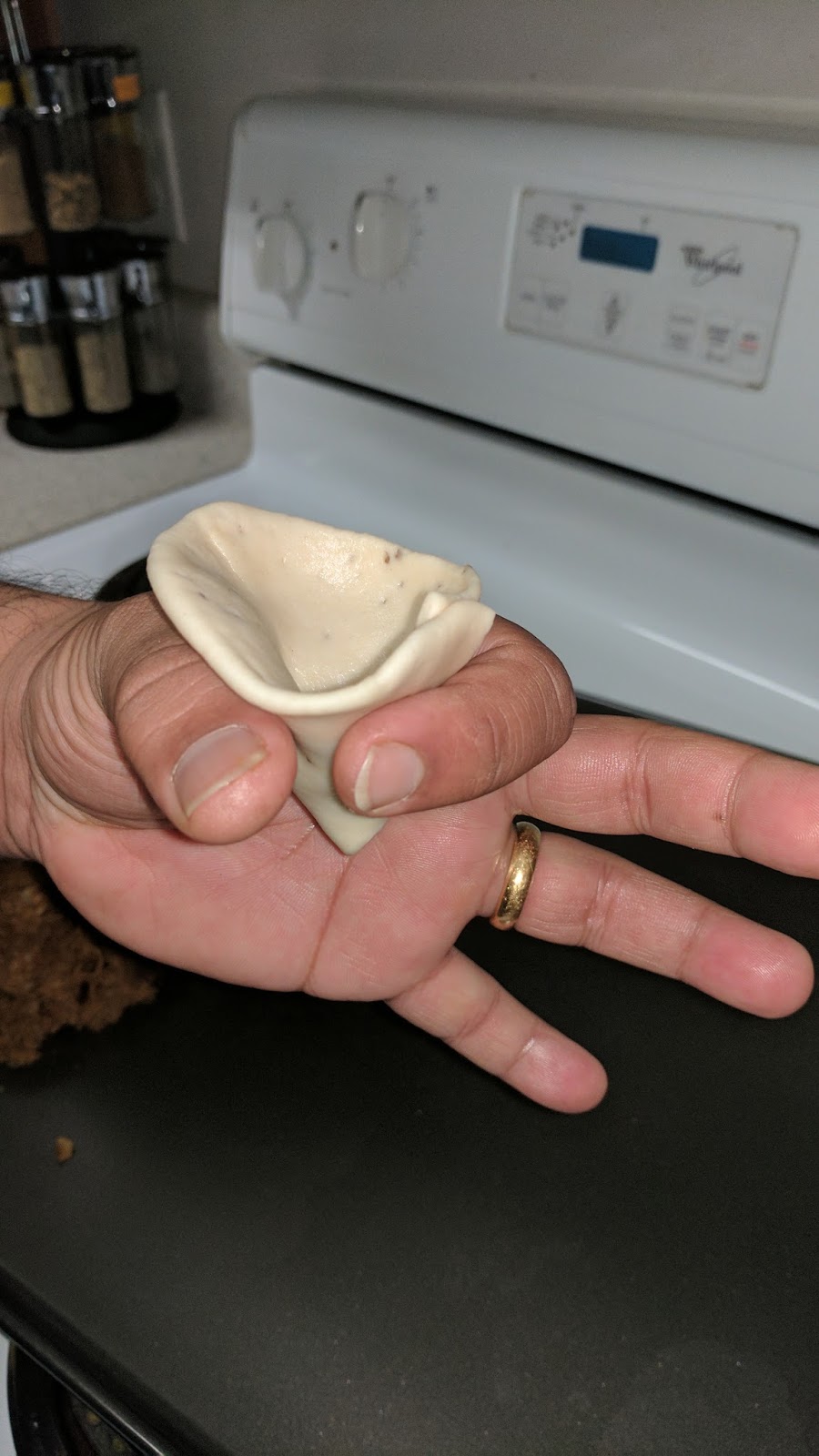
  • Now take a piece of rolled dough on your palm and apply just a little water all around the edges.


  • Join the two edges together to form a triangular cup.


  • Take about 2 spoonfuls of stuffing and fill it inside the cup. Make sure you are holding the cup properly. Also do not over fill.
  • Press the remaining two edges of the dough together to seal the cup securely. Make sure it is sealed properly on all the sides otherwise the stuffing will break and spill in the oil.


  • Put the prepared Samosa on a baking sheet and mold the rest.


Let’s fry the Samosas:
  • Once all the Samosas have been molded, it’s time to fry them.
  • Heat a wok over medium heat. We want the Samosas to be crispy and their color golden brown so keep the heat balanced so that the Samosas do not get burned. If they are changing color quickly turn down the heat a bit.
  • Flip sides so that they get fried evenly.
  • Remove with a spider spoon and drain on paper towels. 
  • Serve hot with Dhania chutney.


Recommended Reading:

Thursday, 29 December 2016

How to make Tamarind Pulp?


In my article Allahabad - The City of Good Food, I have mentioned a tasty beverage called Jeera Jal which means cumin water. This cool beverage is prepared by mixing water with Cumin Powder, Black and White Salts, Tamarind Pulp with a little Mint paste. This is a cool refreshing beverage and is often served as a summer drink in India. 

Tamarind is an important part of Indian cuisine and is used in a variety of chutneys and dishes. If you have never tasted tamarind before, mind it, it’s very tart. Tasting Tamarind can be potent on your taste buds so just dip a finger into the pulp and then suck on it, you will instantly feel all the taste buds drooling trying to immerse themselves in the new flavor.

In North India Tamarind is often sold as a candied toffee with a coating of sugar on top of dried Tamarind. Teenagers love to eat Tamarind because of its sweet tangy taste but it also has many health benefits. People often consume it for digestion relation issues and also for swollen joints. It is also known to be used for metal polishing. Tamarind pulp is used in many other cuisines as well, in fact, I read somewhere that it is also used in the famous Worcestershire sauce. 

I always make a Tamarind pulp before adding it in any of my dishes. This ensures that we are not accidentally chewing on its seed. To make the pulp, cut a small piece of Tamarind with a sharp knife and put it in a bowl with a cup of water. Put the bowl inside the microwave and heat it on high for 1- 2 minutes. Let it rest for about 5 minutes you will see the pulp has started melting. You can now mash it easily with your fingers. Strain it using a fine mesh strainer and you got your pulp. Use it in chutneys, Sambar or Jeera Jal.


Recommended Reading:

Wednesday, 30 November 2016

Allahabad - The City of Good Food


In my article on Lassi and Namkeens of Loknath, I have mainly focused on one particular place – Chowk and its specialties – Lassi (yogurt based drink) and Namkeen (savory snacks). However, these weren’t the only things I enjoyed during my home trip. Allahabad has dozens of good restaurants and food items and if you are planning to visit this amazing historical and cultural city, I should give you a list of all the good food I enjoyed, so that whenever you are there, you make the most of your trip. Remember good food completes the experience of a great trip. So here are a few yummy dishes which I enjoyed with my family.


My parents gave me a surprise treat at the Grand Continental Hotel in Civil Lines and this photo features Goat Biryani. Biryani is a main course dish and is often served with a yogurt raita. It mainly consists of rice and meat but its preparation is an art in itself. I will just give you a summary as in our home Debarshi is the master chef of Biryani. I have seen him preparing rice and meat separately and mind it they are cooked Al Dante. This step is very important as they are then layered alternatively and slow cooked for some time. The result, delicious perfectly cooked meat and fluffy rice grains. Biryani is always prepared with Basmati rice which is a long grained and flavorful rice.

Now I have to tell you, there are different versions of Biryani all over India but I like the Awadhi version of Biryani which is prepared in Allahabad. Also it will be interesting to point here that in India you can also find vegetarian versions of all the dishes. So if you are a vegetarian yay for you! there are tons of options to choose from and believe me I am only starting.


If you are in Allahabad, you must have some Chaat. Chaat is basically street food though nowadays it is not only prepared by the street vendors but is also served in several restaurants and even in weddings as appetizers. During my last three years in the U.S I have had Chaats in quite a few Indian Chaat cafes of Atlanta, San Jose and San Francisco. However, is it possible for a chatori (a person who loves to eat Chaat) like me to go to her home town and not have some delicious Chaat? Amidst my jet lag and stomach upsets whenever I was well I used to go out with my sister and enjoy some tasty Chaat from the local vendors. This photo features Karela (these are crispy chips prepared with a dough of all purpose flour and served with yogurt, Matar, onions and spices), Alu Tikiya (mashed potato mixed with spices and sometimes filled with paneer or lentils and shallow fried, they are served with Matar, chutney and onions), tomato for preparing Tamatar (another dish prepared by sautéing tomato pieces with cumin seeds and the Alu Tikiya dish. The tomato is cooked and mashed in the dish and spices like cumin powder are added, this is then garnished with some yogurt and cilantro) and one thing which is missing from this photo is my all time favorite – Phulki (these are like small deep fried puffed breads and these are served either with Jeera Jal or with Chutney Matar).


Photo features: Phulki with sweet and tangy chutneys and at Atlanta’s Chaat Café, its served with sprouted grains and mashed potatoes.

Hmm... lots of new sides and they all sound so tasty, right? let me tell you what all these yummy sides are:

Chutney – prepared by grinding Cilantro, Green Chilies and some spices with a little water. Also sometimes there is a version of sweet chutney served with the Chaats and it is prepared by boiling Tamarind and Jaggery. The mixture is then strained and used as chutney. The sweetness of Jaggery cuts the tartness of tamarind creating a yummy combination of flavors.

Matar – these are dried Peas. Yes, the regular green sweet peas are dried and used for this dish. You can find these in the Indian stores. Matar is prepared by boiling the dried peas with a pinch of baking soda, turmeric and salt.

Jeera Jal – Jeera means Cumin and Jal means water. This cool beverage is prepared by mixing cold or normal water with Cumin Powder, Black and White Salts, Tamarind or Lemon Water with a little Mint paste. This is a cool refreshing beverage and is often served as a summer drink in India.

Jaggery – This is cane raw sugar. In India many sweet and savory dishes are prepared using Jaggery instead of sugar. Its always available in the shape of a block and is golden brown or dark brown in color. Its considered to have health benefits as it helps in digestion. Growing up I have seen my grand ma and parents consume Jaggery on a regular basis. It is eaten like dessert (last course) often with a bowl of milk. 


Now let’s move on to another of my favorite snacks – Samosa. This is a deep fried pastry filled with spicy potato and sometimes peas. Samosas have their own versions in every state of India but its unique triangular cone like shape remains more or less the same. Although nowadays we get many versions of Samosas (filled with meat, paneer or lentils) my favorite is the traditional one where the filling is made of fried mashed potatoes and spices. I love the Samosas of Allahabad as they have the perfect crust and filling ratio. Because of their small size they are super crispy. The crust holds the filling perfectly and it doesn’t crumble with the first bite. Samosa is the most popular street food during rainy season. I have enjoyed many such Chai (Tea) Samosa party with my friends. Its an ecstatic feeling to watch the rain pour down while gossiping and eating a hot crunchy snack. Samosa is usually served with the green Dhania (Cilantro) chutney although sometimes it is also served with a tart Tamarind Cilantro Green Chili chutney.


This is another good restaurant where I went with my sister and parents. This is not a super expensive place but the food is great. The name of the restaurant is Dilli Galiyara and the best part is, it is inside a mall with a movie theater which was obviously a convenient option for me. I often used to go to the mall to do some shopping and having delicious Indian food always makes me happy. This photo features Paneer Tikka and Chicken Chow Mien. Chow Mein is a pasta based dish. The pasta is fried on a medium- high heat with the vegetables and chicken. It is then flavored with soy and red and green chili sauces. As you can see, we have plenty of vegetables in the chow mein like Carrots, Cabbage and Bell Peppers. Chinese cuisine in India has been developed to suit the taste and flavor pallets of Indians. Its called the Indian Chinese cuisine because its an adaptation of the Chinese cuisine and believe me it tastes totally different than the Chinese foods we enjoy in the U.S. In India, Chinese dishes have a huge variety of vegetarian options as well like Paneer Manchurian, Chili Paneer or Schezwan Paneer to name a few.

Now let me tell you about Paneer Tikka. Paneer is fresh cheese and as I have written in my previous articles is very different from Tofu. Prepared with curdled milk, Paneer should be handled with care and consumed fresh. Paneer tikka is a Tandoori dish which means it is prepared in a clay oven. This creates a smoky fragrance in the dish and brings a charred look. Paneer Tikka is usually served as an appetizer with a mint chutney. It is a widely popular dish served in parties and weddings.


And while you are in Dilli Galiyara, don’t forget to order the Sundae from them. It’s the perfect way to end a delicious meal. For those who don’t know, Sundae is an ice cream dessert decorated with a syrup and toppings like nuts, fruits or whipped cream.


Now let’s move on to serious desserts. This photo features Cakes from one of the most popular bakeries of Allahabad – Paradise. This is my go-to place for any delicious dessert. You can see that the cakes have been specially labelled as “Egg Cake” and that is because many cakes are also prepared eggless for the vegan (vegetarian) population. The sweet treats are endless and I for one get absolute mesmerized with all the options. Some of the cakes in these shelves are: Fruit Trifle, Black Forest and Chocolate Fantasy.


I think it will be correct to say that Indian pastries bear a remarkable similarity with French pastries. We realized this when we went to the Amelie’s French Bakery and Café in Charlotte, North Carolina. They had the exact soft pastries topped with whipped cream, chocolates and fruits. Indian pastries are actually very different than the American muffins and pies and you should definitely give it a try. So let’s see what’s on these shelves, I see Black Forest, Pineapple Exotic, Éclairs, Exotic Truffle and Mango Toon pastries.

You can also find all sorts of breads and cookies in this bakery. Burgers, Sandwiches, Pizza and my favorite – Patties. Patties are prepared by filling a dough parcel with cooked vegetables or meat. The filling is pre cooked with spices and the parcel is then baked crisp. The flaky crispy dough tastes very much like a croissant. 

I was so happy to go to this old bakery with my sister and Debarshi. We shared a couple of sweet and savory dishes and went back home happily.

There are a lot of places in Allahabad with tons of great food and I hope you will enjoy these yummy dishes whenever you are in my hometown. 

Remember “People who love to eat are always The Best PEOPLE”.


Recommended Reading: